 Karmandir
जय बजरंगबली
About
Hanuman ji is the greatest devotee of Shri Ram and one of the best-loved gods of India. He is the son of Mata Anjana and the vanara king Kesari, and Vayu, the wind god, is held to be his spiritual father. Many traditions also see him as a form of Shiv ji. He is honoured for his strength, courage, wisdom and, above all, his humble service to Ram ji. He is believed to be a chiranjeevi, one who lives on through the ages. Devotees worship him especially on Tuesdays and Saturdays, and Goswami Tulsidas's Hanuman Chalisa is recited in countless homes every day.
The story
When Hanuman ji was a small child, he woke up very hungry one morning. He saw the rising red sun, thought it was a ripe fruit, and leapt into the sky to eat it. Indra, the king of the devas, was alarmed and struck the child with his vajra (thunderbolt). It hit him on the jaw (hanu), and he fell to the earth. That is how he came to be called Hanuman.
Seeing his son hurt, Vayu, the wind god, was deeply grieved. He carried the child into a cave and stopped all the air in the world. Every living being began to suffer. Then all the devas came to comfort Vayu, the child was made well again, and each god gave him a blessing. Indra said his body would be as strong as the vajra, and other gods promised that fire, water and wind would never harm him.
As a boy, Hanuman was very playful and often teased the rishis in the forest. They gave him a gentle curse: he would forget his great powers until someone reminded him.
Many years later, the vanaras searching for Mata Sita reached the shore of the southern sea. Lanka lay far across the water, and no one could cross it. Then wise Jambavan reminded Hanuman ji of his true strength. At once he remembered his power. Taking Shri Ram's name, he grew huge and leapt across the ocean to Lanka, where he found Mata Sita and gave her Ram ji's ring as a sign.
How they are shown
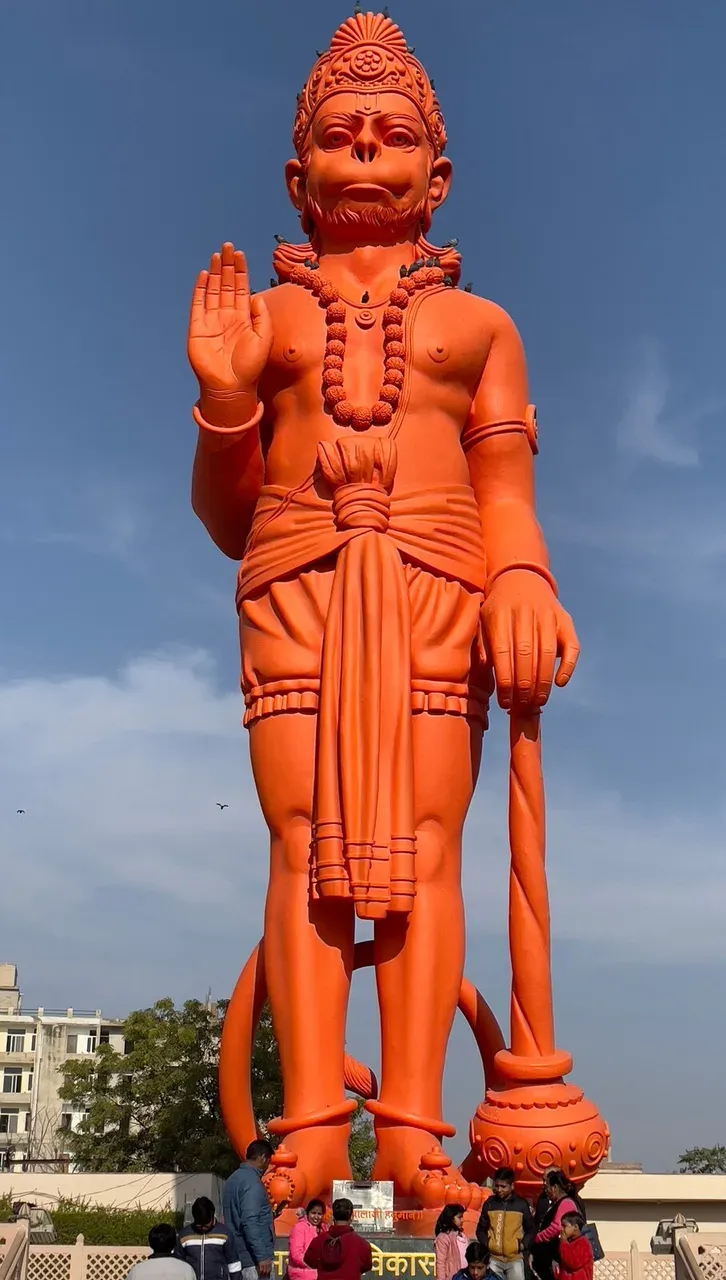
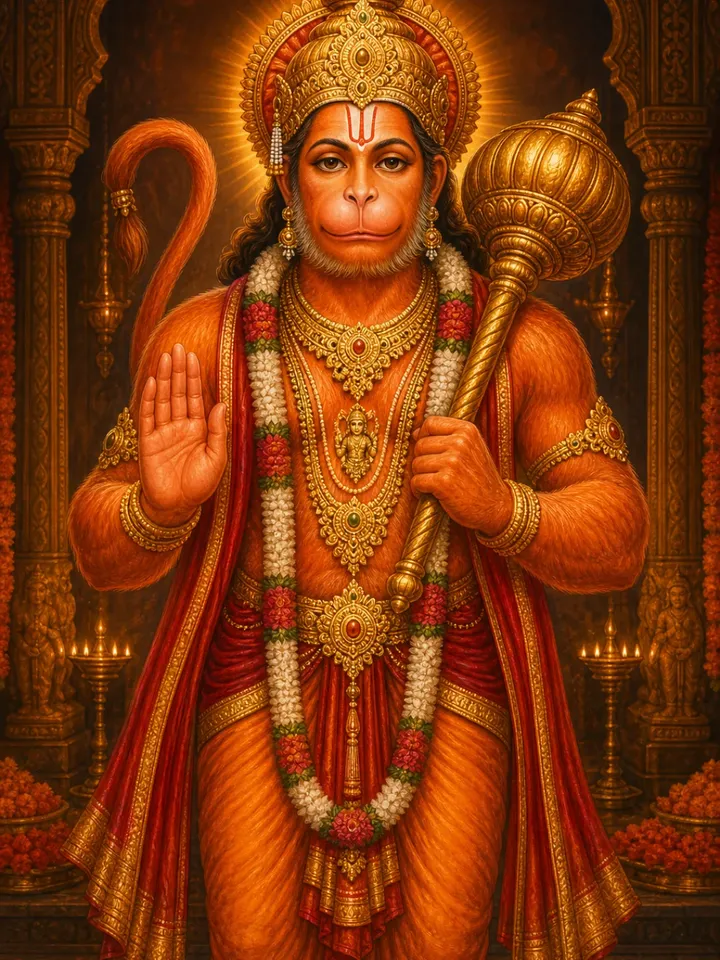
Hanuman ji is shown with a vanara face and a strong body. Devotees cover his murti with orange sindoor, so he often looks saffron-orange. He carries a gada (mace), a sign of strength used to protect dharma. Many pictures show him lifting a mountain in one hand, recalling how he brought the Sanjeevani herb for Lakshman ji. Sometimes he kneels before Shri Ram with folded hands, a sign of humble devotion. In the Panchmukhi form he has five faces. His raised palm (abhaya mudra) tells devotees: do not be afraid.
How to worship
Tuesday and Saturday
Boondi or besan laddoo, gur-chana (jaggery with roasted gram), fruits and paan; red flowers and sindoor. At temples, sindoor mixed with chameli (jasmine) oil is offered as the 'chola'.
On Tuesday or Saturday, after your bath, light a diya of ghee or mustard oil before Hanuman ji's picture. Offer red flowers, a little sindoor and laddoo or gur-chana. First remember Shri Ram, because Ram's name is dearest to Hanuman ji. Then read the Hanuman Chalisa, once or as many times as you can, and sing 'Aarti Keeje Hanuman Lala Ki'. Many families read the Sundarkand on Tuesdays or Saturdays. You may chant 'Om Hanumate Namah' 108 times as a prayer for courage. At the end, share the prasad with everyone at home.
Their festivals
- Hanuman Jayanti (Hanuman Janmotsav) Chaitra Purnima (North India); some South Indian states keep a different date
- Hanuman Jayanti (in some traditions) Kartik Krishna Chaturdashi (Narak Chaturdashi, Chhoti Diwali)
- Bada Mangal Every Tuesday of the month of Jyeshtha, especially in Lucknow and Uttar Pradesh