 Karmandir
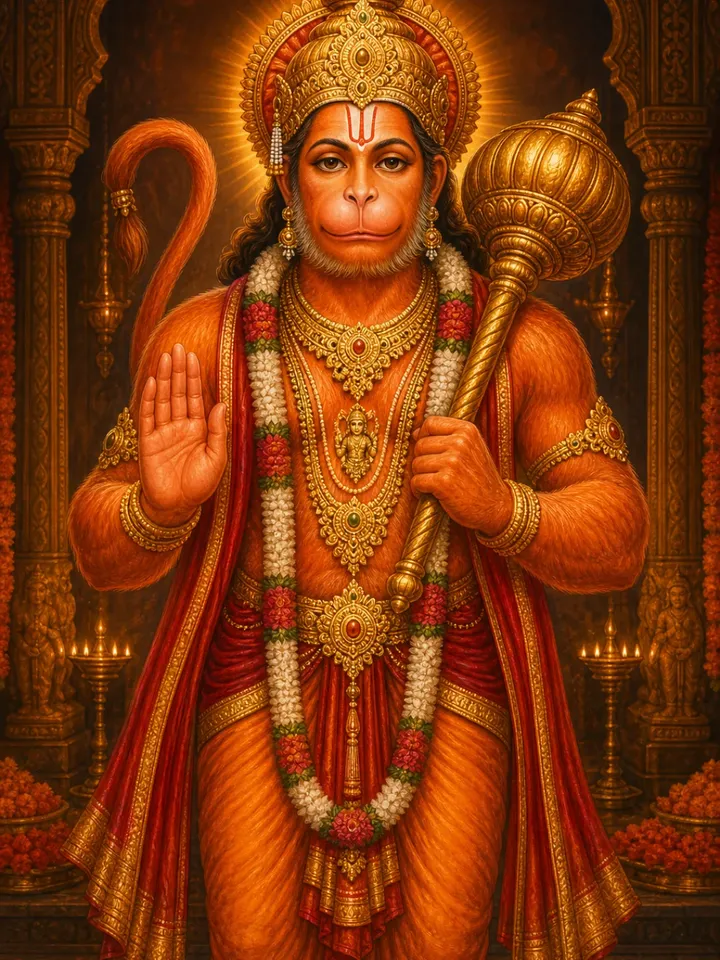
Searching for Sita, a group of monkeys with Angad, Jambavan and Hanuman reached the seashore in the south. They learned that Sita was across the sea, in Lanka. But in front of them lay the huge blue ocean, a full hundred yojanas wide!
One by one, the monkeys said how far they could jump. One said ten yojanas, another twenty, another fifty. But no one felt they could cross a hundred yojanas and come back again. Everyone grew sad.
Hanuman was sitting quietly to one side. Then old, wise Jambavan came to him and said, "Hanuman, why are you so quiet? You are the son of the Wind! As a baby you leapt towards the sun, thinking it was a fruit. No one has strength and wisdom like yours. Get up. Only you can do this!"
As soon as he heard this, Hanuman remembered all his strength. He stood up, and his body grew bigger and bigger. All the monkeys shouted with joy, "Jai Shri Ram!" Hanuman climbed Mount Mahendra. He bowed to Surya Dev, Indra Dev, Pavan Dev and Brahma ji, and took a mighty leap. He flew through the sky like an arrow.
On the way, Mount Mainak, with its golden peaks, rose up from the middle of the sea. It said, "Hanuman, you must be tired. Rest on me for a while and eat some fruit." Hanuman touched the mountain kindly with his hand and said, "Thank you, but I will not rest until Ram's work is done." And he flew on.
Then the gods sent Surasa, the mother of the serpents, to test him. Surasa blocked his way and said, "No one can pass without entering my mouth." Hanuman made his body bigger, and Surasa opened her mouth even wider. This happened again and again. Then clever Hanuman suddenly became as small as a thumb, darted into her mouth and came straight out again! Folding his hands, he said, "Mother, your word is kept. Now please let me go." Surasa was pleased and blessed him: "Go, and complete Ram's work."
Crossing a few more troubles on the way, Hanuman at last landed on the shore of Lanka. Only one thought filled his mind: "I must find Sita Mata."
The lesson Believe in yourself, and finish your work before you rest.
Source: Valmiki Ramayana, Kishkindha Kanda 65–67 and Sundara Kanda 1 (retold)