 Karmandir
जय सिया राम
About
Shri Ram is revered as the seventh avatar of Lord Vishnu. He was born in Ayodhya to King Dasharath and Queen Kaushalya, in the Raghu clan of the Sun dynasty. His life is told in Maharishi Valmiki's Ramayan and in Goswami Tulsidas's Ramcharitmanas. Because he kept to dharma, truth and his given word in every situation, he is called Maryada Purushottam, the ideal among men. Devotees worship him together with Mata Sita, his brother Lakshman and his devoted Hanuman ji. In many families 'Ram' is the first name spoken in the morning, and 'Ram Ram' and 'Jai Siya Ram' are everyday greetings.
The story
In the Treta Yug, King Dasharath of Ayodhya had no children. After a great yagya, four sons were born to him: Ram to Queen Kaushalya, Bharat to Queen Kaikeyi, and Lakshman and Shatrughna to Queen Sumitra. As young princes, Ram and Lakshman went with Rishi Vishwamitra to guard his yagya. In Mithila, King Janak had vowed that Sita would marry the prince who could string the great bow of Shiv ji. Many kings failed, but Ram lifted the bow, and as he strung it, it broke in two. So Ram and Sita were married.
When Dasharath wished to crown Ram, Queen Kaikeyi, swayed by her maid Manthara, asked for two boons he had once promised her: the throne for Bharat and fourteen years in the forest for Ram. To keep his father's word, Ram left for the forest with a smile. Sita and Lakshman went with him.
In the forest, Ravan, the king of Lanka, carried Sita away. While searching for her, Ram met Hanuman ji and the vanara king Sugreev. Hanuman ji leapt across the sea to Lanka and found Sita. The vanara army built a bridge over the sea, and after a fierce battle Ram defeated Ravan. Tradition celebrates this victory as Dussehra. When Ram returned to Ayodhya, the people welcomed him with rows of lamps, a memory kept alive in Diwali. His rule became known as Ram Rajya, remembered as the ideal of justice and happiness.
How they are shown
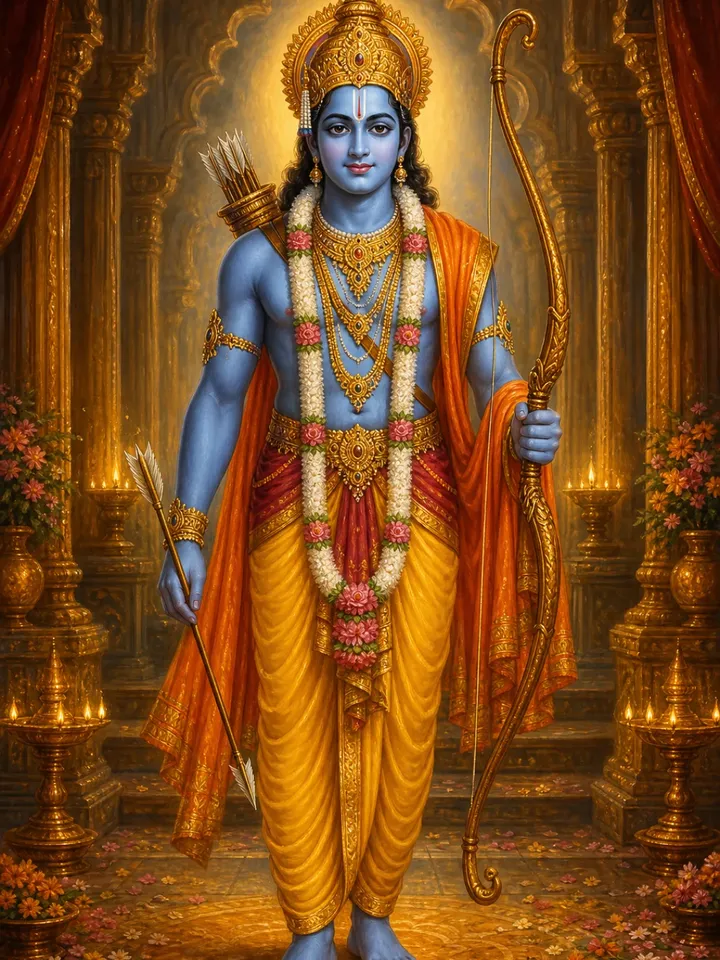
Shri Ram is shown with a dark (shyam) complexion, a golden crown and yellow garments. He holds a bow in his left hand and an arrow in his right, with a quiver on his back. The bow and arrow show that he is always ready to protect dharma and good people. In the Ram Darbar picture, Mata Sita sits at his right, Lakshman ji stands at his left with his bow, and Hanuman ji kneels at his feet with folded hands. It is an image of the ideal family and of true devotion.
How to worship
Kheer, fruits, laddoo and panchamrit, always with a tulsi leaf.
Keep a picture of Shri Ram, ideally the Ram Darbar with Sita ji, Lakshman ji and Hanuman ji. Light a ghee diya and dhoop, and offer flowers and a tulsi leaf. Chant 'Shri Ram Jai Ram Jai Jai Ram' 108 times, or simply repeat the name 'Ram' with love. Read a few chaupais of the Ramcharitmanas or the Ram Raksha Stotra, then sing 'Aarti Keejai Shri Raghuvar Ji Ki'. Offer kheer or fruit as bhog and share it as prasad. There is no one fixed weekday for Ram ji; his name can be taken every day.
Their festivals
- Ram Navami Chaitra Shukla Navami
- Sita Navami (Janaki Jayanti) Vaishakh Shukla Navami
- Dussehra (Vijayadashami) Ashwin Shukla Dashami
- Diwali Kartik Amavasya
- Vivah Panchami Margashirsha (Agahan) Shukla Panchami