 Karmandir
जय जय श्री हित हरिवंश
About
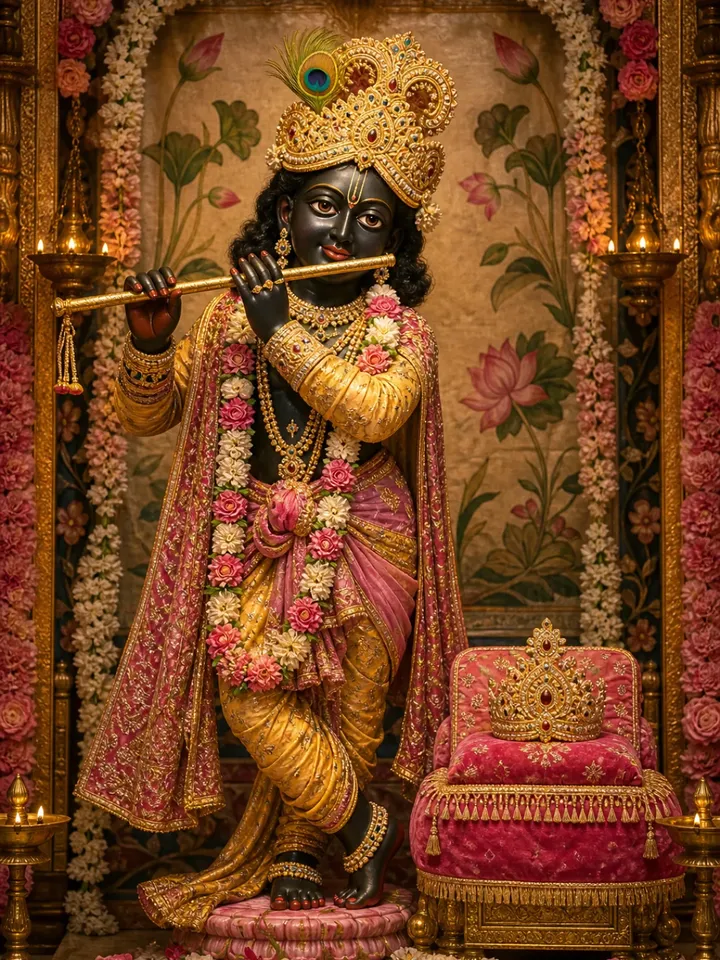
Shri Radha Vallabh Ji is the form of Shri Krishna worshipped in the Radha Vallabh temple of Vrindavan. 'Radha Vallabh' means 'the beloved of Radha'. The temple is the main shrine of the Radha Vallabh tradition, begun in the 16th century by Shri Hit Harivansh Mahaprabhu. In this tradition Shri Radha holds the highest place, and devotion rests on 'hit', which means pure, selfless love. There is no separate murti of Radha here; a crown placed on a seat beside Krishna marks her presence. Braj Bhasha songs, the temple's group singing (samaj gayan) and lovely flower decorations (phool bangla) are its special joys.
The story
By temple tradition, the murti of Shri Radha Vallabh Ji was never carved by any craftsman. An ancestor of a Brahmin named Atmadev did long tapasya to Lord Shiv on Kailash. Pleased, Shiv ji asked him to choose a blessing. The devotee asked for whatever was dearest to Shiv ji himself. Then Shiv ji brought out this form of Shri Radha Vallabh from his own heart, gave it to him and taught him how to serve it.
Devotees believe Hit Harivansh Mahaprabhu was the incarnation of Krishna's flute. From childhood he was devoted to Shri Radha. Tradition says he lived at Devavan in Saharanpur and later set out for Vrindavan, inspired by Radha Rani. On the way, at the village of Charthawal, Atmadev gave him his two daughters in marriage and, at the wedding, gifted him this very murti.
Reaching Vrindavan, Harivansh ji began the seva of Radha Vallabh Ji on Kartik Shukla Trayodashi at 'Oonchi Thaur' (Madan Ter) on the bank of the Yamuna. That day is still celebrated as Patotsav. Later the Lord was seated at Seva Kunj and then in a temple of red sandstone. Temple accounts say this temple was built around 1585 by Sundardas Bhatnagar, a disciple of Vanchandra ji, the son of Harivansh ji. That old building is known today as the 'Hit Mandir'.
How they are shown
The dark murti of Radha Vallabh Ji stands in the graceful tribhanga pose with a flute at his lips. Beside him, a crown rests on a cushioned seat as the sign of Shri Radha's presence. Having no separate murti of Radha expresses the feeling that Radha and Krishna, though two, are one in love; many devotees believe both are present in this single form. On Sharad Purnima the Lord wears white clothes and a crown.
How to worship
Makhan-mishri, peda, barfi and laddus; khichdi in the winter months of Paush and Magh
Light a diya before a picture or murti of Shri Radha-Krishna at home and begin the puja by saying 'Jai Jai Shri Hit Harivansh'. Offer makhan-mishri or fruit. In this tradition, chanting the name 'Radha' is the most loved practice, so spend a few quiet minutes taking Radha's name. Read or listen to the songs of the Hit Chaurasi or the verses of the Radha Sudha Nidhi. Most important is the feeling of love: wishing for the Beloved's happiness before one's own, which this tradition calls 'tatsukh'.
Their festivals
- Hitotsav (Shri Hit Harivansh Jayanti) Vaishakh Shukla Ekadashi (an eleven-day festival)
- Radha Ashtami Bhadrapad Shukla Ashtami (a nine-day festival)
- Patotsav Kartik Shukla Trayodashi
- Sharad Purnima Ashwin Purnima
- Jhulan (swing) Utsav Shravan Shukla Tritiya to Purnima
- Khichdi Utsav The months of Paush and Magh
Aarti, chalisa and katha
Temples and tirth
Sources
- en.wikipedia.org/wiki/Radha_Vallabh_Temple,_Vrindavan
- en.wikipedia.org/wiki/Radha_Vallabha_Sampradaya
- en.wikipedia.org/wiki/Hith_Harivansh_Mahaprabhu
- hi.wikipedia.org/wiki/राधावल्लभ_सम्प्रदाय
- brajrasik.org/articles/588e624858f4ac271a08b963/shri-radha-vallabh-div…
- bharatdiscovery.org/india/हित_हरिवंश
- bharatdiscovery.org/india/हित_चौरासी
- bhaktibharat.com/mandir/radha-vallabh-mandir-vrindavan
- shubhpanchang.com/hi/temples/shri-radha-vallabh-mandir
- radhavallabhmandir.com/hitotsav/
- radhavallabhmandir.com/radhasthmi/
- radhavallabhmandir.com/patotsav-shri-hit-vrindavan-mahotsav/
- radhavallabhmandir.com/sharad-poornima/
- radhavallabhmandir.com/jhulan-utsav/
- radhavallabhmandir.com/khichdi-utsav/